
WHY I STARTED DRAWING VHS TAPES
Sometime around 2005–07, not long after I returned to South Carolina from Chicago, my father came out to my studio. The studio is in an old warehouse building my family also uses for storage, and at the time we had a large dumpster outside the loading dock. We were clearing out years of accumulated things—furniture, clothes, appliances, all the ordinary household objects that eventually lose their usefulness.
My father had packed our family's VHS tapes into garbage bags and was about to throw them away. He asked if I had any use for them.
I didn't. But I couldn't let him throw them away.
I think that was the first time I became conscious of having difficulty getting rid of something from my past simply because it no longer had a purpose. The tapes hadn't been useful for years. I kept them anyway, without knowing what I would do with them. For a long time they just followed me around the studio, stacked in corners or stored in cabinets.
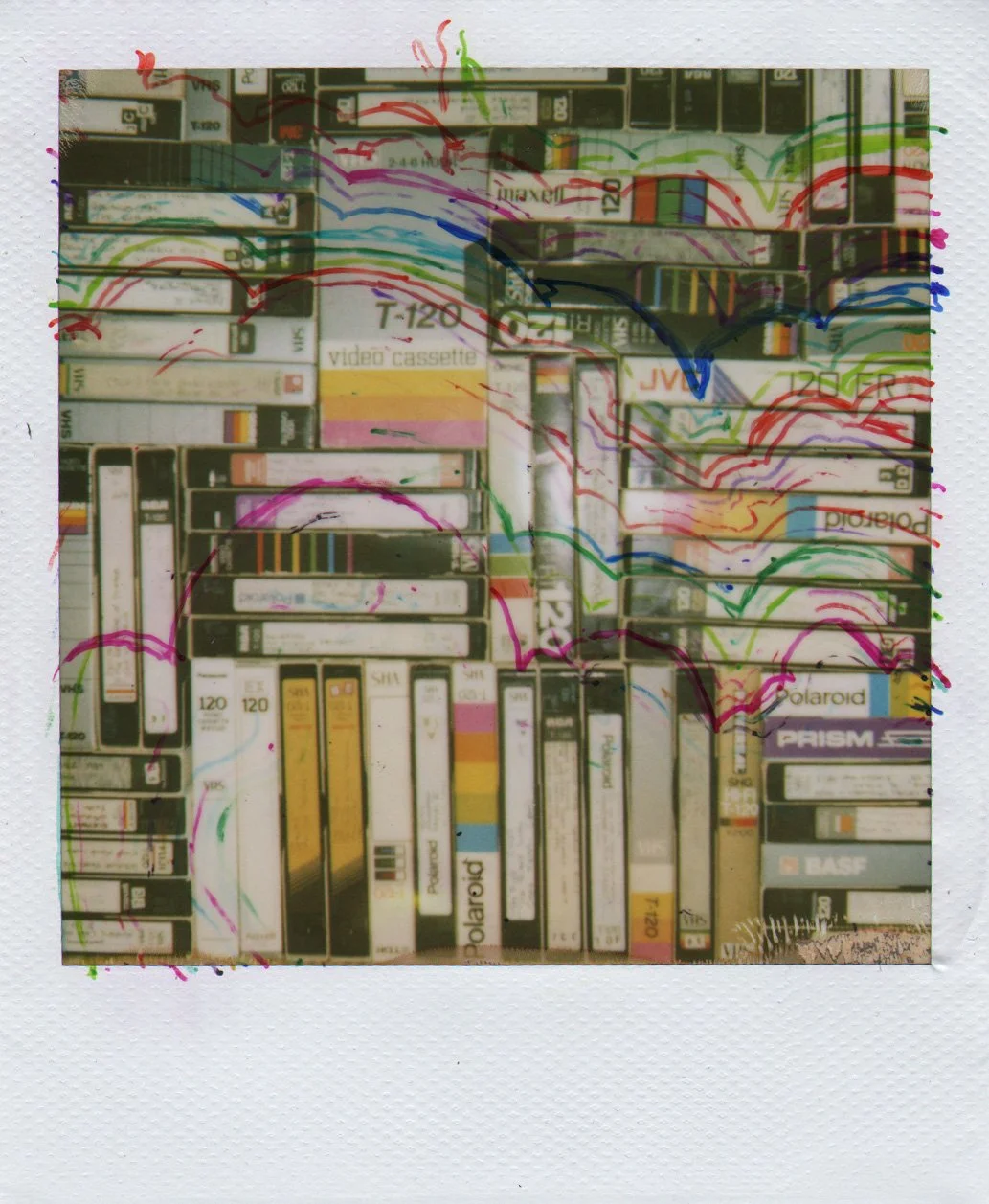
VHS — Polaroid and marker, 2008
I tried photographing them, but the photographs always felt nostalgic in a way I wasn't interested in. At the time VHS hadn't yet become the cultural shorthand for the 1980s and 90s that it is now. It was still just an awkward, recently obsolete format—more like an 8-track tape, cassette, or old Nintendo cartridge that had simply run its course.
The first drawings came in 2008. I was working with the print-on-demand company Infectious, which was producing a series of skateboards. The long, narrow format made me think about lining the tapes up in a row. I made five or six 8 × 10 inch drawings that could be joined together into a continuous image for the skateboard.
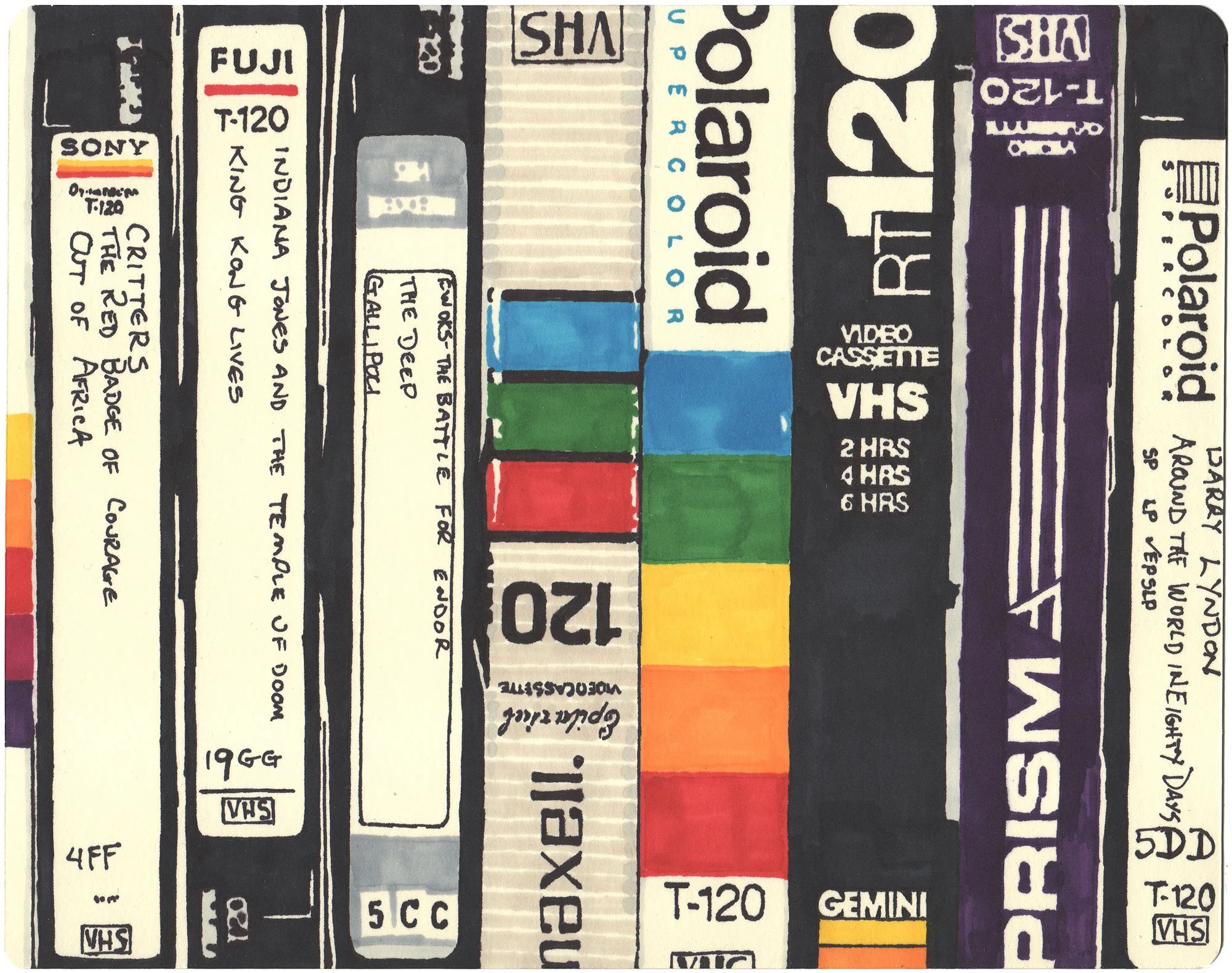
VHS — permanent marker on paper, 8 x 10 inches, 2009
I loved drawing them.
What interested me wasn't just the VHS cassette itself, but what happened when the tapes were seen together. A horror movie might sit beside a children's cartoon. Some had been recorded from regular television, with commercials sometimes carefully removed and sometimes left intact; others came from HBO, Cinemax, Showtime, or The Movie Channel. Together they formed a strange record of what passed through our house.
They were also unmistakably ours. My father had handwritten the titles and numbered the tapes according to a system he devised, with an alphabetized index written on paper and kept in a three-ring binder. Trying to reproduce his handwriting became as important to me as drawing the object itself. The tapes were mass-produced objects shared by millions of households, but the handwriting, numbering, selections, and mistakes turned our collection into something personal.
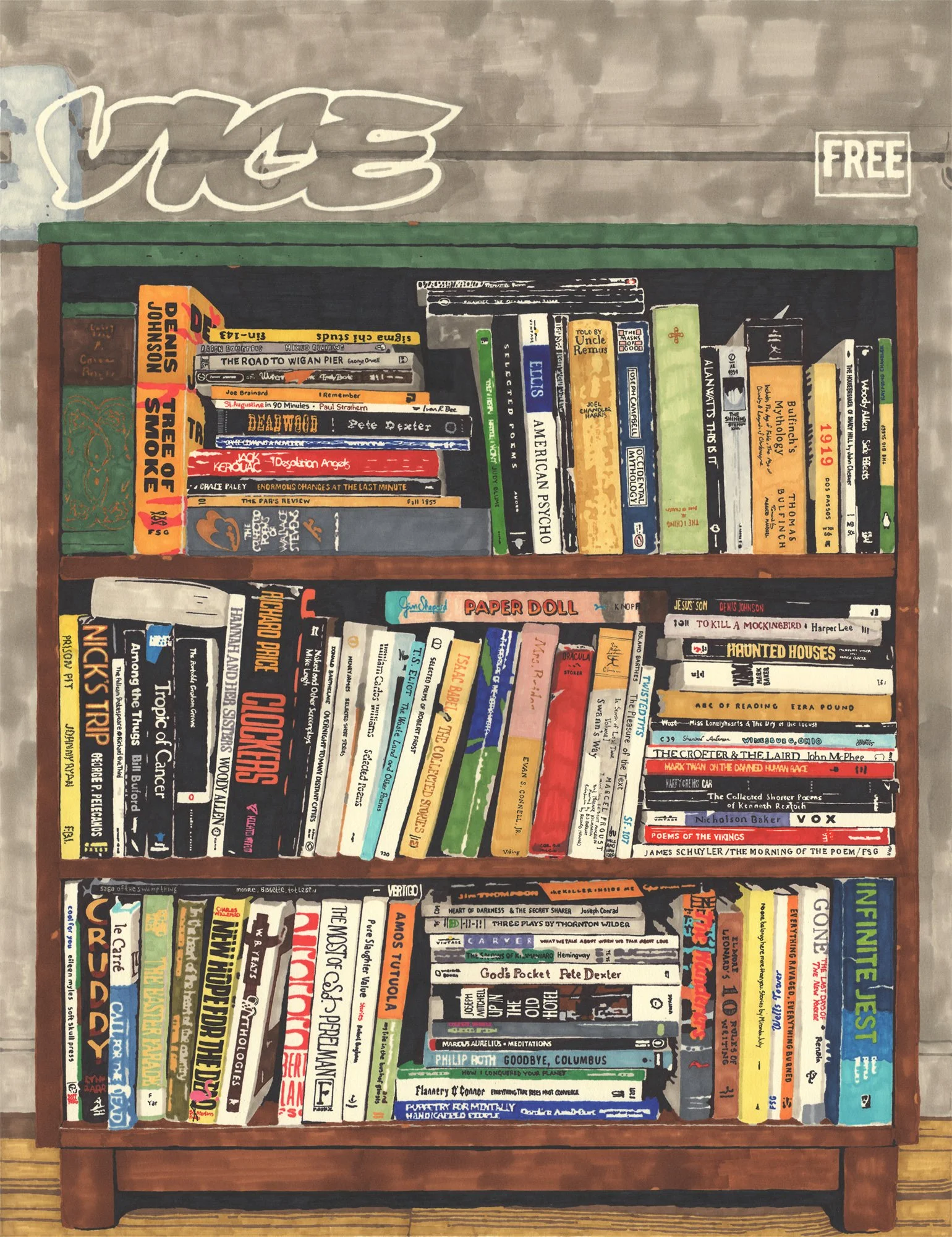
Vice Magazine, The Fiction Issue — cover drawing, 2009
In 2009, Vice Magazine commissioned an image for its Fiction Issue. I drew a bookshelf filled with VHS tapes, stacked much as they would have been in someone's home. That expanded the idea from individual tapes into an accumulation—a collection of fragments of movies, television, advertising, handwriting, and family history.
I've continued returning to them ever since.
What interests me now is that these objects were originally attempts at preservation themselves. We recorded television because we wanted to watch something again. We made home movies because we wanted to hold onto an experience. We taped movies rather than buying expensive commercial copies. In different ways, all of it was an attempt to save something—to keep an image, an event, or a moment from disappearing.
Now the objects we used to preserve those things have themselves become obsolete.
The tapes remain as artifacts of that effort: culturally familiar but individually specific, filled with information that becomes harder to recover as the technology and context around it disappear.
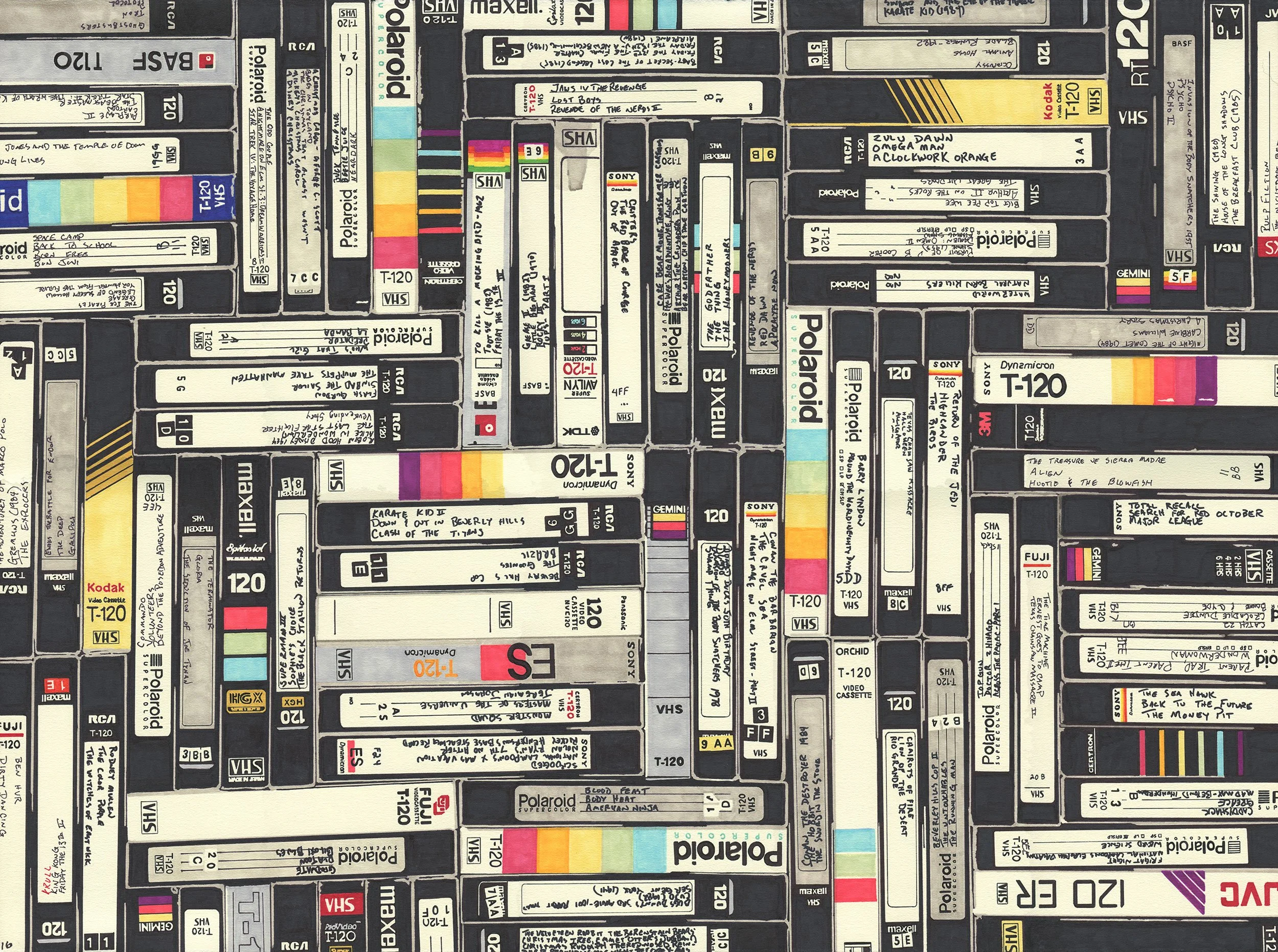
VHS — permanent marker on paper, 23 × 30 inches, 2019